
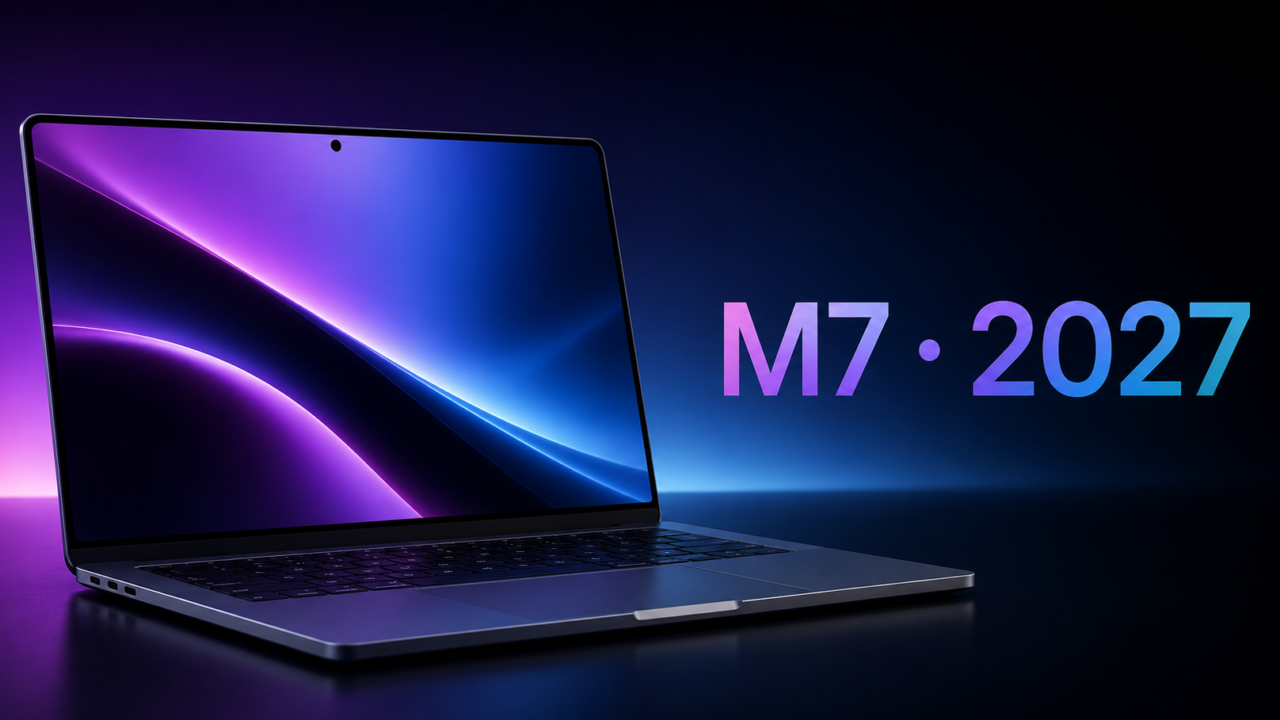
Here’s a pleasant surprise for anyone eyeing a new Mac on a budget: Apple’s cheapest MacBook Pro is about to get the big redesign a lot faster than history says it should. According to a new report from Bloomberg’s Mark Gurman, Apple has an M7-powered, redesigned entry-level MacBook Pro lined up for spring 2027 — and it’ll inherit the fresh look barely six months after the pricey models get it.
If you know how Apple usually rolls out new designs, you know that’s borderline unheard of. Let me break down what’s coming, why the timing is such a big deal, and whether it’s worth holding off on a purchase.
Why is ” six months ” the real headline here
Normally, when Apple gives the MacBook Pro a new design, the entry-level model waits years to catch up. The pattern is remarkably consistent:
- Apple redesigned the MacBook Pro with the Touch Bar in 2016, but the base model didn’t get it until 2019 — three years later.
- The gorgeous 14-inch redesign landed in 2021 with the M1 Pro and M1 Max, yet the cheapest MacBook Pro clung to the old 13-inch body until 2023, when it finally moved to the 14-inch chassis with the M3 chip.
So the base model historically trails the flagship by two to three years. This time? Reports point to roughly a six-month gap. That’s a massive shift, and it means budget buyers won’t be stuck staring at a five-year-old design while everyone else enjoys the new one.
For context, the current MacBook Pro look has been around since fall 2021 — that’s about five years on the same chassis. It’s aged well, but “stale” is a fair word at this point. You can browse the full MacBook Pro model history by year and chip if you want to see just how long Apple has ridden this design.
What the redesign actually brings
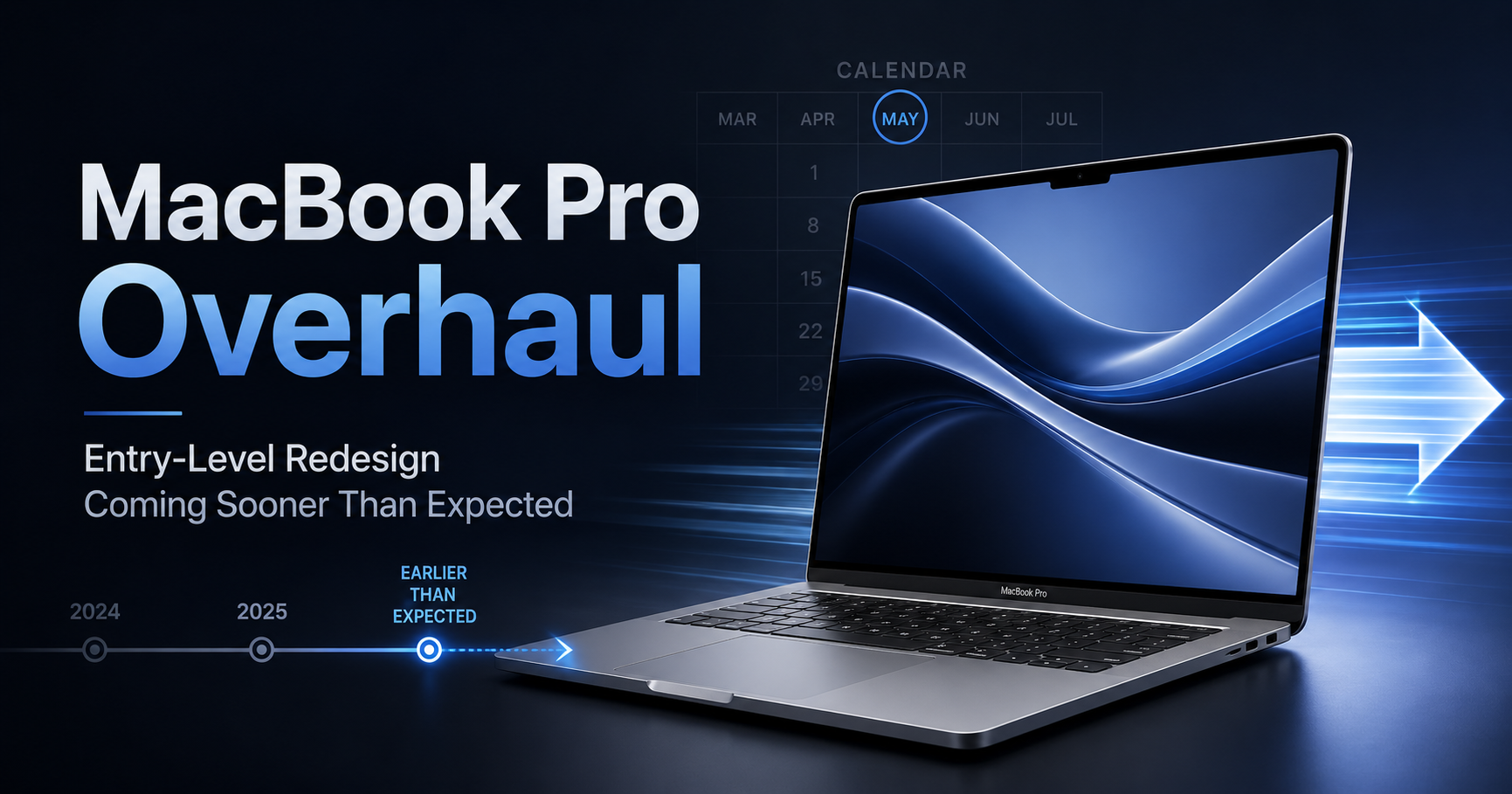
The redesigned entry-level machine is reportedly a 14-inch model, code-named K104, and it borrows its styling from the higher-end MacBook Pros Apple plans to launch between late 2026 and early 2027 (the ones rumored to carry a “MacBook Ultra”-style branding).
Here’s what the new design language reportedly includes:
- A slightly thinner chassis and slimmer display bezels
- A punch-hole camera cutout replacing the current notch
- A revised port layout
- On the high-end models: OLED displays with touchscreen support, and possibly a Dynamic Island–style interface
One important nuance a lot of coverage glosses over: multiple outlets report the entry-level K104 likely won’t get the touchscreen itself. It appears to adopt the external design language — the thinner body, the slimmer bezels, the punch-hole camera — while the OLED-plus-touch experience stays a premium, higher-tier feature, at least for this generation. So temper your expectations there; the base model gets the fresh face, not necessarily every headline feature.
The chip roadmap got genuinely weird
This is where it gets confusing, so stick with me. Apple’s silicon plan for this stretch is unusual on a couple of fronts.
First, the redesigned high-end MacBook Pros arriving late 2026 / early 2027 are expected to ship with M5 Pro and M5 Max chips — not the M6 generation you’d assume. That’s because Apple reportedly decided to skip the M6 Pro and M6 Max entirely, pouring its resources into accelerating the M7 instead.
Second, that fast-tracked M7 chip is the star of the entry-level K104. Reports peg it as built on a 2-nanometer process, heavily optimized for on-device AI, with memory bandwidth around 240 GB/s — a big jump from the base M5’s 153 GB/s. If the timeline holds, the redesigned entry-level MacBook Pro could actually be the first Mac to ship with next-gen M7 silicon. The beefier M7 Pro and M7 Max chips aren’t expected until later in 2027.
The timeline, laid out simply
Apple’s MacBook Pro plan over the next year-plus shakes out like this:
- Fall 2026 — An entry-level MacBook Pro (code-named J804) with the M6 chip and the current design, launching alongside the redesigned high-end models running M5 Pro / M5 Max.
- Spring 2027 — The redesigned entry-level MacBook Pro (K104) with the M7 chip and the new look.
- Fall 2027 — A high-end MacBook Pro refresh moving up to M7 Pro / M7 Max.
So there’s a transitional M6 model this fall that keeps the old body — think of it as the last hurrah for the 2021 design at the entry level — before the K104 brings the overhaul in spring.
Worth noting: this is all part of the same Bloomberg report that also flagged four new iPad Pro models for spring 2027, keeping the same 11-inch and 13-inch sizes with mostly internal upgrades and possible vapor-chamber cooling.
What it means for your wallet
Now for the part that actually matters day-to-day. Thanks to the ongoing global memory shortage, Apple has been raising prices across the Mac line — the entry-level MacBook Pro now starts at $1,999, which is roughly what the Pro-chip versions cost less than a year ago. Ouch.
That price climb is exactly why this news is a win for budget-minded buyers. The redesigned high-end 14-inch MacBook Pro with an M5 Pro chip will very likely run north of $2,500. But if you want the same modern design without the flagship price tag, you’ll only have to wait until spring 2027 for the M7 entry-level model. For a lot of people, that’s a far easier pill to swallow.
The obvious caveat: Gurman’s report explicitly warns that the same memory and chip shortages could still push these dates around. Nothing here is locked in, and Apple hasn’t commented. Treat the timeline as a strong plan, not a promise.
Should you buy now or wait?
Here’s my honest take, and it comes down to your situation:
Wait for the M7 (spring 2027) if you specifically want the new design, you’re not in a rush, and you’re comfortable riding your current machine for several months to a year. Getting a fresh look and next-gen silicon at the entry-level price is a genuinely good deal by 2027 standards.
Buy now if you need a machine today, or you’d rather avoid the risk of a delayed timeline due to a supply crunch. And if you’re buying now, you don’t have to pay Apple’s inflated new-retail prices — a certified refurbished MacBook Pro gets you a fully tested machine, warranty included, for meaningfully less than that $1,999 sticker.
Either way, if you’re upgrading, don’t let your current Mac gather dust. First, look up your exact model so you know precisely what you’ve got — the chip and configuration make a real difference to its value — then check what it’s worth right now and get a trade-in quote to sell it. Selling the old one takes a real bite out of the cost of the next one, whenever you buy.
Bottom line
Apple compressing a years-long design rollout down to about six months is a real shift — and for once, it favors the people buying the cheapest MacBook Pro rather than making them wait. Between the accelerated M7, the modern design, and a price that undercuts the flagship by hundreds, the spring 2027 entry-level MacBook Pro is shaping up to be one of the more compelling Macs Apple’s put out in a while… assuming the supply chain cooperates.
Are you holding out for the M7 redesign, or grabbing something now? Either way, it’s a good time to know what your current Mac is worth.
Related reading: MacBook Pro vs. MacBook Air (M5, 2026): Which Should You Buy? · Look up any Mac’s specs and macOS compatibility at Techable’s Apple specs hub. Timeline and specs are based on reporting from Bloomberg, 9to5Mac, AppleInsider, and Digital Trends, and remain subject to change.