
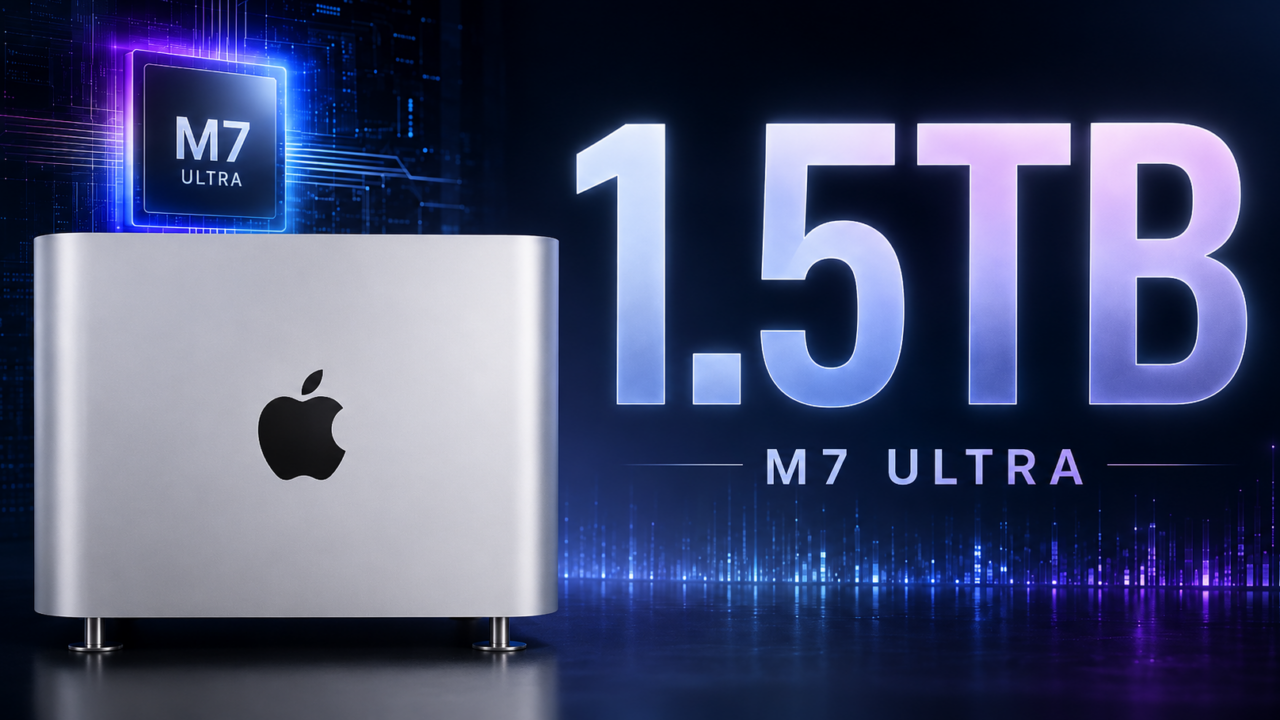
Here’s a number that stops you in your tracks: 1.5 terabytes of RAM. According to a new report from Bloomberg’s Mark Gurman, that’s how much unified memory Apple is engineering its upcoming M7 Ultra chip to support. If it ships, it would be the most memory ever crammed into an Apple Silicon machine, and it would finally let Apple’s in-house chips match a milestone the 2019 Intel Mac Pro hit seven years ago.
It’s a wild full-circle moment. Let me break down what’s actually going on, why it’s taken this long, and the deeply ironic backdrop this news is landing against.
What Gurman reported
In the latest edition of his Power On newsletter, Gurman says Apple is designing the M7 Ultra to handle as much as 1.5TB (1,536GB) of unified memory, roughly double the ceiling planned for the M5 Ultra, which tops out at 768GB. That would blow past every previous Apple Silicon record and land Apple Silicon right where the maxed-out 2019 Mac Pro sat: 1.5TB.
The big caveat: Apple engineering the chip to support that much memory doesn’t guarantee you’ll be able to buy it configured that way. Gurman notes the ongoing global memory-chip shortage could force Apple to cap the shipping configuration lower. So think of 1.5TB as the ceiling Apple is building toward, not a promise.
Why Apple Silicon has always been RAM-limited
If you’ve ever wondered why even Apple’s priciest Macs cap out at far less memory than a comparable PC workstation, the answer is unified memory. Apple packages the RAM directly onto the same module as the processor rather than using separate, slottable memory sticks. That’s what makes Apple Silicon so fast: data doesn’t have to travel far, so bandwidth is enormous, and the CPU, GPU, and Neural Engine all share one pool.
The trade-off is capacity. Because the memory has to physically fit alongside the chip, there’s a hard ceiling on how much you can include, and no way to upgrade it later. That architectural reality is exactly why hitting 1.5TB is such a milestone: Apple has to engineer the packaging to physically accommodate that much memory. It’s not a spec bump; it’s a real engineering leap.
The 2019 Mac Pro parallel
The headline comparison here is poetic. Back in 2019, Apple’s Intel-based Mac Pro, the cheese-grater tower, could be configured with up to 1.5TB of RAM using traditional slotted DDR4 memory. When Apple began transitioning Macs to its own silicon in 2020, raw memory capacity was one of the few areas where the old Intel machines still won. For years, Apple Silicon simply couldn’t match that number.
Now, with the M7 Ultra, Apple Silicon is finally poised to close that last gap, while keeping the massive bandwidth advantage unified memory brings. It’s taken most of a decade, but the round trip is nearly complete.
The irony: Apple is cutting RAM options right now
Here’s the twist that makes this report so striking. At the exact moment Apple is engineering a 1.5TB monster, the memory shortage is forcing it to shrink the options on machines you can buy today.
Earlier in 2026, Apple quietly pulled the highest-memory configurations from the current M3 Ultra Mac Studio, first the 512GB tier, then lower ones, leaving buyers with a far smaller ceiling than before. Apple also raised prices across its Mac and iPad lines, a move outgoing CEO Tim Cook reportedly described as responding to a “hundred-year flood,” pinning the blame on AI server demand vacuuming up the high-bandwidth memory that would otherwise go into consumer hardware.
So the same shortage that’s squeezing today’s Macs is the very thing that could stop the 1.5TB M7 Ultra from ever shipping at full capacity. Apple is designing for abundance in a moment of scarcity. (This is the same component crunch behind the recent Mac price hikes, including the entry-level MacBook Pro jumping to $1,999, which we covered in our M7 MacBook Pro redesign breakdown.)
This isn’t really about spreadsheets; it’s about AI
Let’s be honest: almost nobody needs 1.5TB of RAM to edit video or run a design studio. So what’s the point?
Massive unified memory is a killer feature for running large AI models locally, without the cloud. For reference, the current M3 Ultra with 512GB can already run models like DeepSeek’s R1 at 671 billion parameters. Double that memory to 1.5TB, and you’re potentially in range of running models north of a trillion parameters right on your desk. Reports even suggest the M7 Ultra could underpin Apple’s first dedicated server hardware, putting Apple Silicon in the ring against NVIDIA, AMD, and Intel in the data center.
In other words, this is Apple building the memory headroom to compete for serious on-device and enterprise AI workloads, the area where the whole industry is racing right now.
The price will be brutal
Let’s talk cost, because it’s eye-watering. Based on Apple’s current memory pricing of roughly $25 per gigabyte, jumping to 1.5TB from a 128GB base would tack on more than $35,000, just for the RAM, before you’ve paid for the rest of the machine. And that’s using today’s pricing; if the shortage worsens into 2027, it could climb further. This is firmly professional and enterprise-focused, not a tool for the average creative.
Where the M7 Ultra fits in Apple’s roadmap
To set expectations: the M7 Ultra isn’t right around the corner. Apple is reportedly running an unusual, compressed chip roadmap that skips the high-end M6 generation entirely, with no M6 Pro, Max, or Ultra. Here’s the rough shape of it:
- Late 2026: An M5 Ultra Mac Studio arrives as a bridge, with up to 768GB of memory, itself a new Apple Silicon record.
- First half of 2027: The base M7 debuts (first in a redesigned entry-level MacBook Pro).
- Late 2027: The M7 Pro and M7 Max follow.
- 2028: The M7 Ultra lands, reportedly in a future Mac Studio with a redesigned heat sink to handle heavier AI loads, and that potential 1.5TB ceiling.
So the 1.5TB dream is likely a 2028 story, with the M5 Ultra holding down the high end until then.
Bottom line
The M7 Ultra matching the 2019 Mac Pro’s 1.5TB memory ceiling would be a genuine landmark, the moment Apple Silicon finally erases the last advantage its old Intel machines held, all while keeping unified memory’s speed. Whether it actually ships at full capacity depends entirely on a memory market that’s currently working against Apple, and the price will keep it firmly in pro- and enterprise hands. But as a statement of where Apple wants its silicon to go, straight into serious local AI, it’s hard to top.
As always with Gurman’s roadmap reporting: it’s well-sourced, but nothing here is official until Apple says so, and 2028 is a long way out.
Curious how the rest of Apple’s lineup is shifting? Look up any Mac’s specs and macOS compatibility at Techable’s Apple specs hub, and see why the Mac resale market keeps growing as pros cycle through hardware faster than ever. Sourcing: Bloomberg’s Mark Gurman via 9to5Mac, MacRumors, Tom’s Hardware, and TechRepublic. Specs and timelines are unconfirmed and subject to change.