
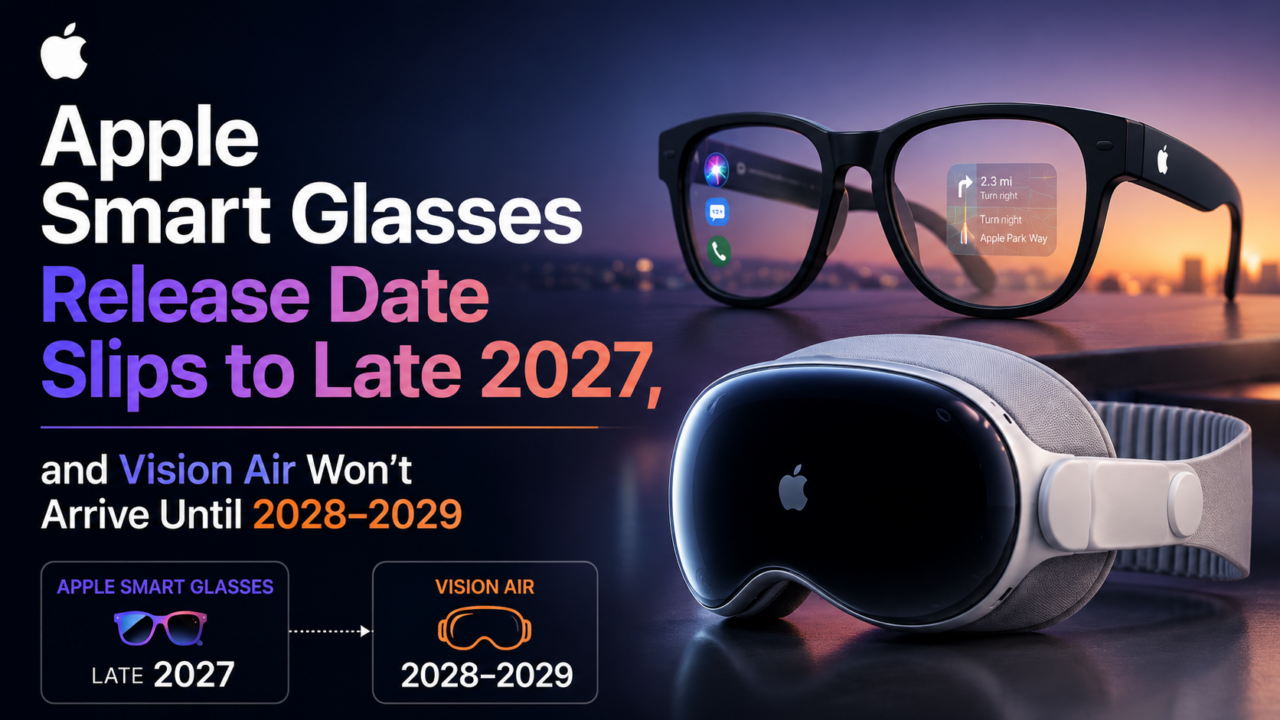
Apple’s long-rumored entry into the smart glasses race just got pushed back again. According to a new report from Bloomberg’s Mark Gurman, Apple’s AI smart glasses, internally code-named N50, are now targeting a late 2027 launch, a full year later than the company’s original plan. Meanwhile, the cheaper, lighter Vision Pro successor known as Vision Air has slipped even further, with a realistic window of late 2028 to 2029.
If you’ve been waiting for Apple’s answer to the Meta Ray-Ban smart glasses, here’s the bad news up front: you’ll be waiting a while longer. Here’s everything we know about the revised timeline, why the delay happened, and what these glasses are actually expected to do.
The new Apple smart glasses timeline at a glance
| Product | Codename | Original target | Revised target |
| Apple smart glasses | N50 | Announce late 2026, ship early 2027 | Launch by the end of 2027 |
| Vision Air (lighter Vision Pro) | N100 | As early as 2027 | Late 2028 or 2029 |
| Next-gen Siri | — | 2026 | Still on track for 2026 |
Why Apple’s AI glasses got delayed
The delay isn’t about the hardware; it’s about the brains.
Apple’s next-generation Siri is reportedly still on schedule to arrive before the end of this year. The real holdup is Apple’s visual AI technology (the camera-driven “Visual Intelligence” features that let the glasses understand what you’re looking at). Reports suggest that the capability may not be polished enough by the original deadline, and Apple would rather wait than ship an underwhelming first-generation product.
That’s a familiar Apple pattern. The company has a history of delaying major new product categories rather than launching something half-baked, and given how much is riding on this being its first genuinely mainstream AI wearable, taking an extra year to get it right is a defensible call.
What are Apple’s smart glasses, exactly?
This is the part a lot of people get wrong, so it’s worth being clear: Apple’s first smart glasses are not a mini Vision Pro.
There’s no in-lens display, no augmented reality overlays, and no spatial computing in the first generation. Instead, the N50 glasses are designed to look like ordinary eyewear and act as a hardware platform for Apple Intelligence, essentially a wearable interface for Siri and Apple’s AI features.
Expected features include:
Built-in cameras for capturing photos and video, and for powering Visual Intelligence (point them at a sign, plant, or restaurant and get instant answers).
Speakers and microphones for calls, audio, and hands-free Siri.
Deep iPhone integration – Like the AirPods or Apple Watch, the glasses will pair with your iPhone and rely on it, rather than be a standalone device.
Multiple frame styles and finishes, with reports of distinctive oval-shaped cameras, unique colors, and several frame designs being tested.
A strong privacy angle built around Apple’s on-device processing.
Over time, Apple reportedly believes the glasses could evolve into a health device and eventually incorporate true augmented reality to enhance how people see the world, but those are later-generation ambitions, not launch-day features.
How much will Apple’s smart glasses cost?
Apple hasn’t confirmed pricing, but the leaks cluster in a sensible range. Most reporting points to a starting price somewhere between $299 and $499, positioning the glasses directly against the Meta Ray-Ban lineup, with premium frame and prescription options potentially pushing higher.
That’s a deliberate strategy. After the $3,499 Vision Pro failed to reach mainstream buyers, Apple appears to be aiming the glasses at the AirPods-to-Apple-Watch price tier, accessible enough to sell in volume.
Apple smart glasses vs. Meta Ray-Ban
Make no mistake: this product exists to challenge Meta. Meta’s Ray-Ban smart glasses have been the breakout success of the category, and Apple wants in on a market that’s growing fast as AI wearables go mainstream.
Apple’s pitch comes down to three advantages:
Ecosystem lock-in. Seamless integration with iPhone, AirPods, Apple Watch, and the broader Apple ecosystem.
Privacy. Apple’s on-device AI approach is a genuine differentiator against cloud-heavy rivals, and a meaningful chunk of potential buyers cite data concerns as a reason they’ve held off.
Design and brand. Apple is openly targeting the enormous global audience that already wears prescription glasses, sunglasses, or frames as a fashion accessory.
The catch? By waiting until late 2027, Apple gives Meta and Google even more time to entrench themselves first.
What about Vision Air?
For a while, it looked like Vision Air, a slimmer, cheaper successor to the Vision Pro, was essentially shelved as Apple shifted resources toward the glasses. Now it appears development has quietly resumed, but don’t hold your breath: a realistic launch window is late 2028 or 2029.
Gurman describes the headset category as effectively “on ice” until then, which means we probably shouldn’t expect anything beyond the current M5 Vision Pro for the next two to three years. Before Vision Air can ship, Apple needs to solve the two problems that sank the original Vision Pro: the bulky design and the eye-watering price.
A bit of perspective makes the wait feel shorter. The original Vision Pro was unveiled back in 2023, so we’re roughly as far from Vision Air now as we already are from that debut.
Should you wait for Apple’s smart glasses?
If you want AI smart glasses today, Apple isn’t your answer and won’t be for nearly two years. The Meta Ray-Ban glasses remain the obvious pick for anyone who wants the experience now.
But if you’re deep in the Apple ecosystem and you care about privacy, a polished first-party experience, and tight iPhone integration, the N50 glasses are shaping up to be worth the wait. The extra development year is a signal that Apple intends to launch a product people will actually want to wear every day, not a tech demo.
Frequently asked questions
When will Apple smart glasses be released?
The latest reports point to a launch by the end of 2027, delayed from an earlier plan to announce them in late 2026 and ship in early 2027.
Will Apple’s smart glasses have a display?
No. The original N50 glasses are said to launch without a display built into the lens, with a version with an embedded display rumored to arrive later, perhaps around 2028.
How much will Apple’s smart glasses cost?
Nothing is confirmed, but leaks suggest a starting price in the $299–$499 range, with premium and prescription options costing more.
What is Apple Vision Air?
Vision Air is a rumored lighter, more affordable successor to the Vision Pro headset. It’s now expected to arrive in late 2028 or 2029.
Do Apple’s smart glasses work without an iPhone?
No. The glasses, like AirPods and Apple Watch, are designed to be paired with and dependent on an iPhone rather than work independently.