
A guy walked into our operation last month with a MacBook he was sure was worthless. Another site had quoted him $180. We paid him $920.
That $740 gap in his money that almost evaporated is the entire reason I’m writing this. After more than 15 years of buying back Apple gear, I’ve come to believe the trade-in industry has a transparency problem so deep that most people don’t even know they’re being shortchanged. They just assume the number on the screen is fair. Usually, it isn’t.
So let me pull back the curtain on how this actually works, why I think it’s broken, and what we’re doing differently.
The dirty little secret of the “instant estimate”
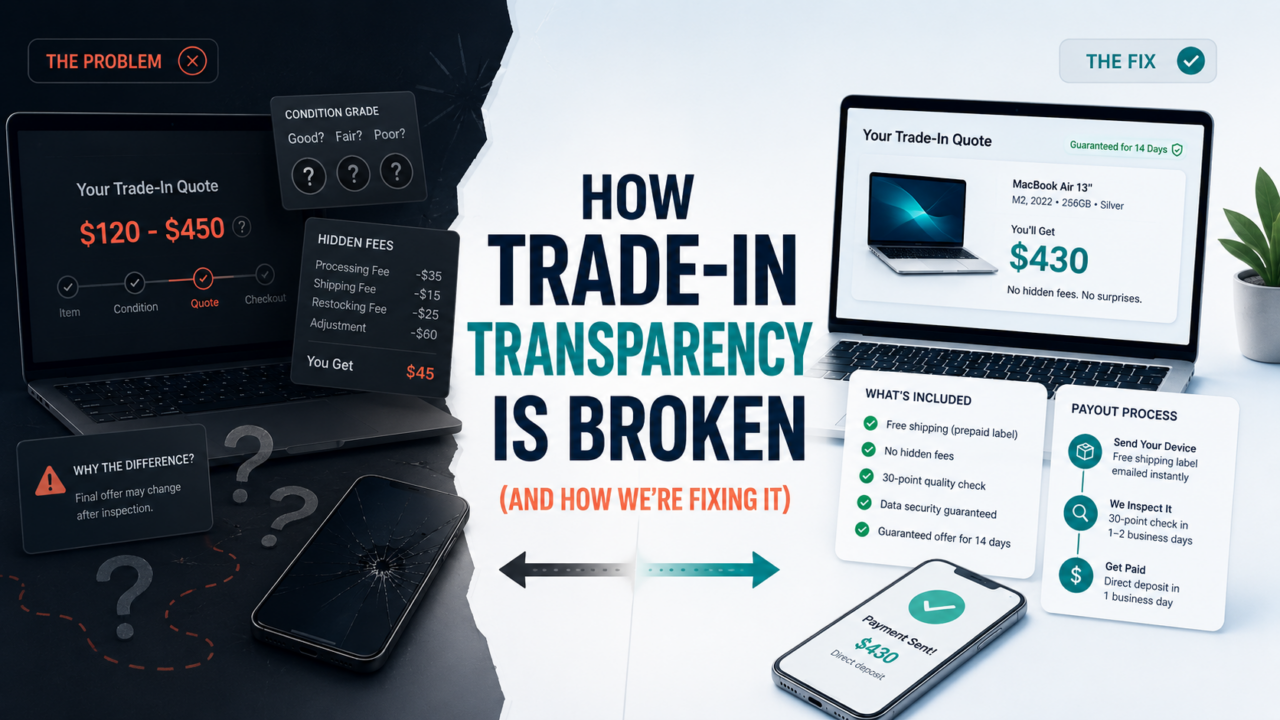
Here’s what I’ve seen play out thousands of times. You search “sell my MacBook” or check your Apple trade-in value, you get an instant quote, and it looks decent. You ship the device. Then three weeks later, you get an email. “After inspection, we’ve revised your offer.” Suddenly, that $600 quote is $310, and your laptop is already 1,500 miles away.
This is not a glitch. In my experience, it’s a business model. A lot of buyback sites bank on two things: that you don’t know your real MacBook trade-in value, and that once your device is in their warehouse, you won’t bother shipping it back over a couple hundred bucks. They quote high to win the click, then “re-quote” low when you’re out of options. That’s not a trade-in. That’s a bait-and-switch with a tracking number.
Store credit is not the same as cash, and the industry blurs that on purpose
The other sleight of hand is the Apple trade-in value itself. On paper, the offers look reasonable. But two things get glossed over.
First, it’s almost always store credit, not cash, money you can only spend back inside the same ecosystem, on their schedule. Second, those offers routinely land 30 to 50% under what the device is actually worth on the open market. If you’re buying a new Mac next week, fine, it’s convenient. But if you wanted real money in your account, you just left a pile of it on the table and didn’t even know there was a table.
Carrier trade-ins are even worse on this front; those “generous” credits often drip out over 24 to 36 months and vanish entirely if you switch providers. When you’re not immediately buying something from the same company, those offers are worth a fraction of what they appear to be.
Why “how much is my Mac worth” is a harder question than it should be
Here’s the part that really bothers me. When someone asks “how much is my Mac worth,” they deserve a straight answer. Instead, the industry has made it deliberately murky.
Prices move constantly; a single new Apple chip announcement can drop the previous generation’s resale value 15 to 20% almost overnight. That volatility is real. But too many companies hide behind it. “We’ll know when it arrives” is code for “we’ll decide how little to pay you once we have leverage.” Opacity isn’t a side effect of a complicated market. For some players, opacity is the product.
And the cost of all this isn’t just financial. It’s trust. Every lowballed seller walks away believing their old device was junk, so the next one ends up in a drawer or a landfill instead of getting refurbished and reused. Broken transparency doesn’t just cost people money. It fuels e-waste.
What real transparency looks like
I think transparency in this business comes down to a simple test: the number you’re shown should be the number you’re paid. Everything we’ve built is organized around making that true.
Here’s what that means in practice:
The quote is locked. When we give you a price, we honor it for 30 days. The offer you accept is the offer that gets funded after inspection, assuming the device matches what you described. No surprise “revisions” once we have your gear.
The pricing is real, not a spinning wheel. Every quote comes from the same internal catalog our buying team actually uses, keyed to your specific configuration, chip, RAM, storage, year, and condition. An M2 Pro with 16GB isn’t averaged in with an M2 Max with 32GB. (Not sure exactly which Mac you have? Our free Apple serial number lookup pins down the exact model in seconds, and that precision is the difference between a fair quote and a guess.) You see the deductions before you submit, not after.
Cash is the default, not the trap. You get paid your way: PayPal, Zelle, bank transfer, or check. Store credit is an option (and we’ll add a bonus if you choose it), never the only door out.
Condition is honest in both directions. Cracked screen, dead battery, won’t power on? We’ll still pay you, because the parts have value. I’d rather quote you fairly on a broken machine than have you toss a $2,000 device.
A real person stands behind it. If something on your quote looks off, you email us and a human replies, usually same day. Not a chatbot designed to wear you down.
If you want to see it work, check what your MacBook is worth right now or get a real quote and sell your MacBook Pro. The number you see is the number we’ll stand behind.
Why I think this is the future, not a gimmick
People ask me if “transparency” is just marketing. It’s a fair question; everybody claims it. So here’s my honest answer: transparency is harder and less profitable in the short term, which is exactly why so few companies actually do it. You make less per device when you can’t lowball. You eat the cost of return shipping when someone declines. You staff actual humans.
But here’s what I’m seeing across the market: customers are getting smarter. They cross-check offers against recent eBay sold listings now. They know “best place to sell a MacBook” isn’t whoever shouts the highest opening number, it’s whoever still pays that number after inspection. The opaque players are running on borrowed time. Trust compounds, and so does its absence.
I built this company on the opposite bet from the rest of the industry: that if you treat people fairly, tell them the truth about what their device is worth, and pay them what you promised, they come back, and they tell people. After 15 years and tens of millions paid out, I’m more convinced of that than ever.
The bottom line
The trade-in industry trained people to expect the runaround, the inflated quote, the quiet downgrade, the store-credit handcuffs. I don’t accept that as “just how it works.” A fair number from a real person, your money in days, no games: that shouldn’t be a competitive advantage. It should be the baseline.
We’re not going to fix the whole industry overnight. But every seller who gets paid what they were promised is one more person who knows what fair actually looks like, and won’t settle for less next time.
Before you accept any Apple trade-in value or buyback offer, please get a second quote and compare. If our number isn’t competitive, you’re not obligated to ship anything. I’d genuinely rather you check than just take my word for it. That, to me, is what transparency means.
Thinking about upgrading? Look up your exact model and macOS compatibility at Techable’s Apple specs hub, see our breakdown of the M5 MacBook Pro vs. MacBook Air, or browse certified refurbished Macs at Techable.