
For most of my career, used technology was treated mainly as the lower-cost alternative to buying new. That view misses what has changed in the Mac market. Apple silicon extended the useful life of many machines, new-device pricing affects the value equation, and buyers have more ways to compare used and refurbished options. From where I sit, those forces have made the secondary Mac market more relevant than it was a decade ago.
What follows combines what we’re seeing in day-to-day resale work with published market estimates. The two should be kept separate: our operating observations are firsthand, while market-size and depreciation figures depend on the methodology of the sources cited below.
What the available market estimates suggest
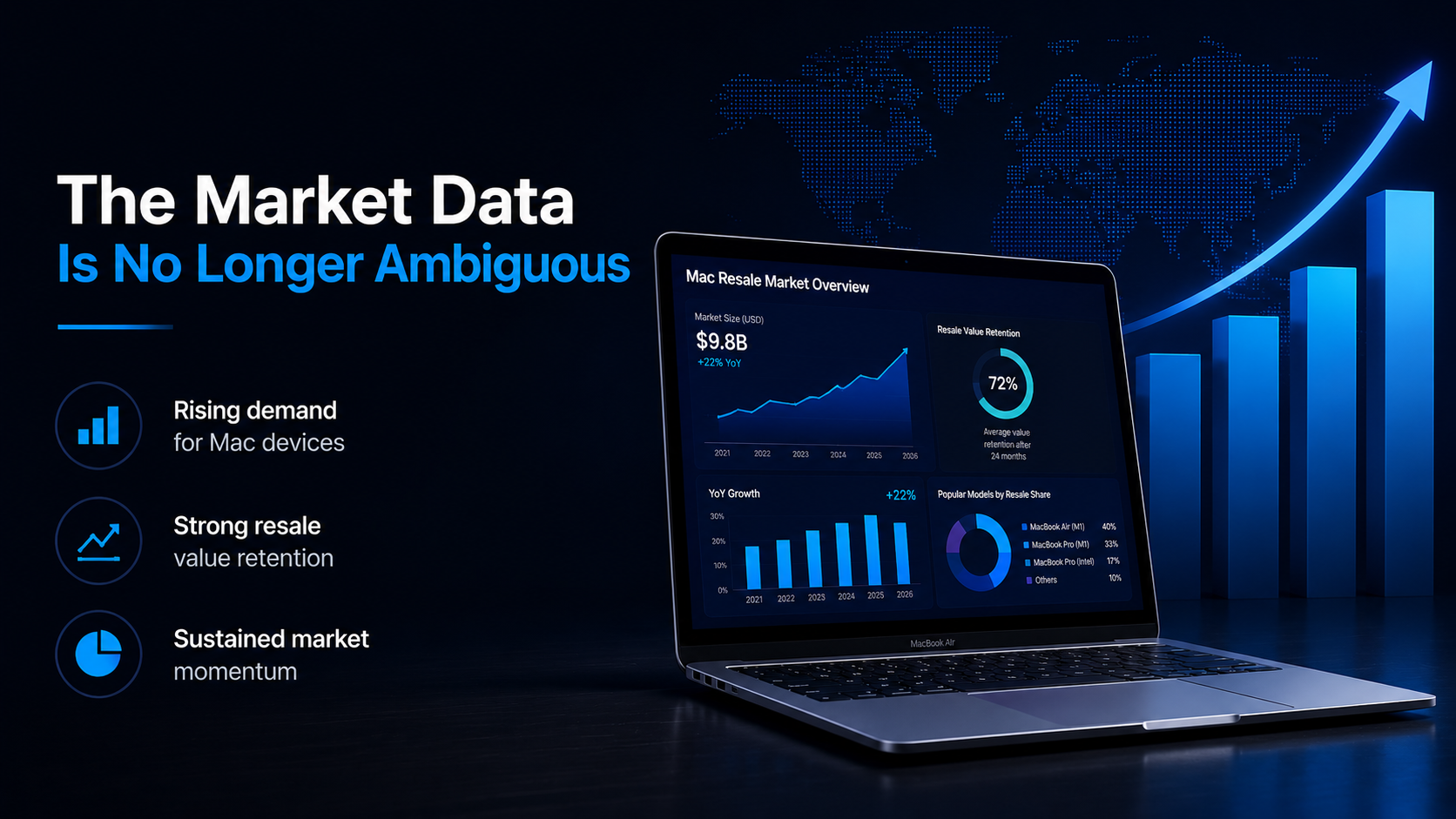
Published estimates point to growth in refurbished computers and laptops, but the exact numbers vary by research firm and by what each report includes. One source cited below estimates the category at roughly $23.9 billion in 2026 and projects continued growth over the next decade. I treat figures like these as directional context rather than a precise measure of the Mac resale market.
Those are not the growth curves of a dying category. They’re the growth curves of a category going mainstream.
Apple Sits at the Top of This Market
Some resale-value sources cited below report stronger value retention for Apple silicon MacBooks than for several comparable Windows laptops, although the percentages vary substantially by model, configuration, condition and methodology. The practical takeaway is simpler: age alone is a poor way to estimate a Mac’s value. Current model-specific resale data is more useful, which is why it pays to check what your specific Mac is worth today.
What’s Actually Fueling the 2026 Surge
It would be easy to wave at “inflation” and “sustainability” and call it a day. The real story is more specific, and it’s the combination of these forces, not any single one, that makes this moment different.
1. New Macs Got More Expensive at Exactly the Wrong Time
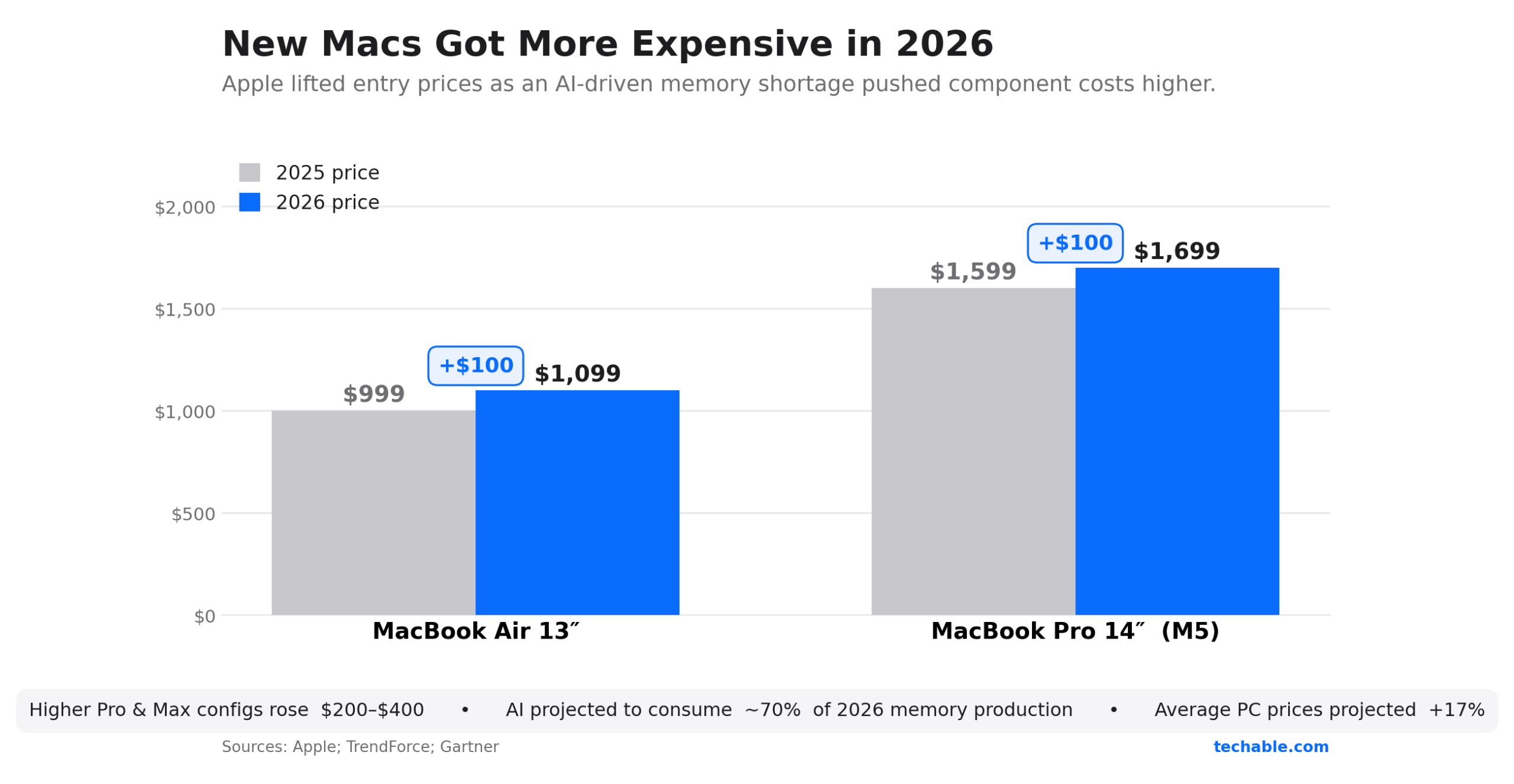
This is the catalyst most people outside the industry are missing. A global memory shortage, driven by AI infrastructure soaking up DRAM supply, has pushed component costs up sharply. Industry analysts project that AI-centric memory could consume around 70% of global memory production in 2026, starving the supply available for ordinary consumer devices, with average PC prices expected to climb roughly 17% this year as a result.
Apple has already moved. The 13-inch MacBook Air’s entry price rose from $999 to $1,099, and the base 14-inch MacBook Pro with the M5 chip went from $1,599 to $1,699, with higher Pro and Max configurations climbing $200 to $400. Layer ongoing tariff pressure on top of that, and the price of buying new has quietly jumped a tier. Every dollar added to a new Mac’s sticker makes the used equivalent more attractive. A comparably specced refurbished MacBook Pro now undercuts a new one by a wider margin than it has in years, and it props up the resale value of the machine someone already owns.
2. Apple Silicon Rewrote the Depreciation Curve
When Apple moved off Intel starting in late 2020, it didn’t just make faster laptops. It extended the useful life of every machine it shipped. An M1 MacBook from five years ago still runs current macOS, handles real professional workloads, and shows no meaningful performance degradation, and these machines are on track for seven to eight years of software support. In my experience, nothing destroys resale value faster than a device that feels obsolete, and Apple Silicon simply doesn’t feel obsolete on the timeline buyers expect. That single architectural decision is the foundation of the entire used-Mac market.
3. 2026 Is the Year the Intel Line in the Sand Became Real
macOS Tahoe is the final macOS version to support Intel Macs. The next release, expected at WWDC in June 2026, will be Apple Silicon only; Intel machines will keep receiving security updates for about three years, but the era of major OS upgrades for them is over. This does two things at once. It pushes the last Intel holdouts to finally trade in an aging Intel Mac and move to an Apple Silicon machine — feeding both inventory and demand into the resale channel. It sharpens the premium on Apple Silicon devices, which now sit clearly on the right side of that divide. We are watching a clean, Apple-enforced dividing line do exactly what such lines always do to a secondary market: concentrate value.

The Buyer Has Fundamentally Changed
The other half of this story isn’t about the machines. It’s about who’s buying them.
Roughly two-thirds of Gen Z now say they prefer secondhand over new, and for many of them, resale is the first place they look, not a fallback. This is the part that older operators in this space consistently underestimate. For a large and growing share of buyers, purchasing a refurbished Mac carries zero stigma, if anything, it signals that you’re smart, financially and environmentally. The circular economy stopped being a marketing slogan and became a default purchasing behavior.
That shift compounds with everything above. You have new prices rising, a hardware platform that holds its value, a software cutoff funneling devices into the market, and a generation that actively wants to buy used. Those forces don’t cancel out. They stack.
What the Maturing Market Demands
I want to be clear-eyed about what this growth actually requires, because rising tides expose weak operators.
The used-Mac buyer of 2026 is far more sophisticated than the buyer of even three years ago. They no longer price a machine by its release year alone. They look at the chip generation first, then RAM, then storage, then battery health, and cycle count. They know that 16GB of unified memory has become the new floor; 8GB models are depreciating noticeably faster as macOS and on-device AI features get hungrier and that a machine with 90%-plus battery health commands full value while a worn one takes a real haircut. These buyers do their homework.
That sophistication is exactly why the next phase of this market won’t be won on price. It will be won on trust. The platforms and operators that provide honest grading, transparent pricing, real warranties, and verifiable device history are the ones that will capture the growth. The ones still treating used Macs like anonymous bargain inventory will get left behind. We’ve built our entire approach around that conviction, because I’m certain it’s where the market is heading.
Where I Think This Goes Next
When I look five years out, I don’t see the resale market as a satellite orbiting the new-device market. I see the two converging. As Apple Silicon stretches device lifespans, as new-device prices stay elevated, and as resale becomes a default consideration at the moment of purchase rather than disposal, the line between “buying a Mac” and “buying a used Mac” keeps blurring. Increasingly, people will buy a new machine partly because they can confidently predict what it’ll be worth in three years treating residual value as part of the purchase math, the way car buyers always have.
That’s the real headline of 2026. The Mac resale market isn’t growing because times are hard and people are cutting corners. It’s growing because the fundamentals finally line up: durable hardware, rising new prices, a generation that prefers used, and a clearer-than-ever quality dividing line. Those are durable tailwinds, not temporary ones.
The used-Mac industry spent two decades being underestimated. It won’t have that problem much longer.
References
Figures reflect the most current 2026 estimates available at the time of writing. Market-research projections vary by firm; readers are encouraged to consult the linked sources directly.
- Future Market Insights. Refurbished Computers and Laptops Market Size, Trends & Outlook 2026 to 2036. https://www.futuremarketinsights.com/reports/refurbished-computer-and-laptops-market
- Gadget Salvation. Which Used Apple Mac Retains the Most Value? https://www.gadgetsalvation.com/blog/which-used-apple-mac-retains-the-most-value/
- MyDepreciation. MacBook Depreciation Calculator / Mac Value Estimator (2026). https://www.mydepreciation.org/calculators/macbook
- Yahoo Finance / South China Morning Post. Here’s How Much Apple Is Raising Prices on MacBook Air, Pro Models (citing TrendForce and Gartner). https://finance.yahoo.com/news/much-apple-raising-prices-macbook-181449413.html